Gemstone Buying Guide


A World of Colour and its Meaning
Gemstones bring colour, character, and emotion to jewellery. For centuries, they have been treasured for their rarity, brilliance, and symbolic significance. From sacred Navrathnas associated with planetary energies to the birthstones celebrated in the West, across cultures, gemstones have been linked to identity and protection.
Anatomy of a Gemstone
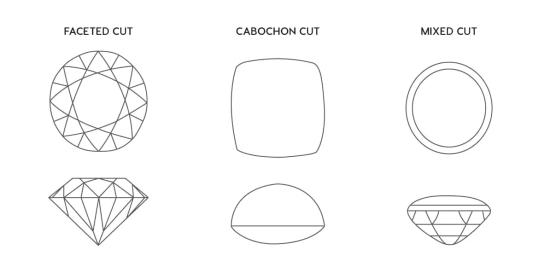
A gemstone is the naturally occurring crystalline form of a mineral. Its structure determines whether it appears transparent, translucent, or opaque. To reveal its finest qualities, each gemstone is shaped through various cutting styles- faceted cuts, smooth cabochons or artistic mixed cuts- each chosen to enhance its natural beauty.
Cut
The cut of a gemstone determines how it interacts with light. In faceted stones, the crown draws in light while the pavilion reflects it back, creating brilliance and scintillation. Because each rough stone is unique, cutters balance proportion, colour and clarity to bring out the stone’s best possible appearance.
Clarity
Clarity refers to the natural inclusions or surface features found within a gemstone. These characteristics are shaped by the geological conditions under which the gem is formed. Some gemstones are typically “eye-clean,” while others- like emeralds- naturally show more inclusions. Clarity is generally understood through three broad types:
- Type I – Usually eye-clean
- Type II – May have minor inclusions visible under magnification
- Type III – Often contains inclusions that are visible to the naked eye
These features can also offer insight into a gemstone’s origin.
Polish
Polish defines the smoothness and refinement of a gemstone’s surface. A high-quality polish allows light to move cleanly through the stone and enhances its sparkle, contributing significantly to its overall presence.
Every gemstone is a product of time, pressure and the earth’s artistry. Their colour, clarity and cut come together to create pieces that are timeless, expressive, unique and deeply personal.
Emerald
Overview
Emeralds are among the most prized coloured gemstones and belong to the beryl family. Their green colour comes from trace amounts of chromium and occasionally vanadium, resulting in hues that range from light green to deep, saturated tones. Other beryl varieties include Aquamarine (blue), Morganite (pink), Heliodor (yellow), and the extremely rare Red Beryl (bixbite). Among all green gemstones, emerald remains the most celebrated worldwide.
Colour
Colour is the most important factor in determining an Emerald’s value. The ideal gemstone displays a rich, vivid green with balanced hue, tone and saturation, even colour distribution and minimal visible zoning.
Clarity
Emeralds commonly feature inclusions and surface-reaching fissures. Clarity is assessed with the unaided eye rather than magnification. Eye-clean emeralds are exceptionally rare. Treatments with colourless oil are widely accepted, as they improve transparency by filling fissures; however, treatments that alter colour are considered misleading and must be disclosed. The most valuable emeralds have intense green colour, good transparency and no visible colour-altering treatments.
Blue Sapphire
Overview
Blue sapphire is a primary colour gemstone prized for its depth of colour, durability and rarity. Its blue hues arise from trace elements of iron and titanium. Because sapphire is dichroic, it can show slightly different colours when viewed from different angles, making the orientation and cutting of the stone critical.
Colour
The most desirable blue sapphires exhibit a vivid, velvety blue with strong saturation. Violet or purple undertones can enhance beauty, while noticeable green components reduce value. Skilled cutters orient the stone to minimise greenish tones in the face-up view.
Clarity
Eye-clean sapphires- especially in larger sizes- are uncommon. Small inclusions are acceptable as long as they do not impair brilliance or transparency.
Special Characteristic: Asterism
Some sapphires display a star-like pattern known as Asterism when cut as cabochons. This phenomenon is caused by fine rutile silk inclusions intersecting in a way that reflects light as a six-rayed star. While silk can enhance collector value, excessive silk can reduce brilliance. Most sapphires are heat-treated to improve colour and clarity; untreated stones with intact natural silk are significantly rarer.
Yellow Sapphire
Overview
Yellow sapphires are admired for their brilliance and lively colour, often compared to fine yellow diamonds. Their hues range from bright lemon yellow to rich golden tones, with deeper orange-yellow shades being especially popular in parts of Asia.
Colour
The colour of yellow sapphire is primarily influenced by iron. Higher iron content produces richer saturation. It’s important to know that untreated, richly saturated yellow sapphires are rare. So, the next time you make that purchase, make sure to ask.
Clarity
Yellow sapphires tend to have fewer inclusions than blue or pink sapphires. High clarity combined with strong saturation is a key value driver. Because rough material is more affordable, cutters often prioritise brilliance, resulting in well-proportioned stones and a variety of fancy cuts such as radiant shapes that enhance colour.
Ruby
Overview
Yellow sapphires tend to have fewer inclusions than blue or pink sapphires. High clarity combined with strong saturation is a key value driver. Because rough material is more affordable, cutters often prioritise brilliance, resulting in well-proportioned stones and a variety of fancy cuts such as radiant shapes that enhance colour.
Colour
Colour is the primary determinant of value. The finest rubies display a vivid, medium-dark red to slightly purplish red with strong saturation. Trade terms such as “pigeon’s blood” are subjective and not universally standardised. Fluorescence can intensify the appearance of colour, and fine rutile silk within the gem can help distribute light and enhance richness.
Clarity
Rubies are evaluated for clarity with the unaided eye. Eye-clean stones are rare, especially in larger sizes. Inclusions that do not diminish brilliance or transparency are generally acceptable. Ruby deposits are found worldwide, but Myanmar (Burma) has historically produced many of the most coveted stones due to their optimal combination of hue, saturation and fluorescence.

Search with an image and find the same or similar jewellery
The file size should not exceed 6 MB
File size exceeds the limit